
Wisconsin WisDOT DMV Permit Practice Test 17
- Questions50
- Correct to pass40
- Passing score80%
- Minimum age15 years
-
1. You are driving down a parking aisle and reach the main lane that runs along the front of the store. What is the usual rule?
Show answer
Answer C: The main through lane has the right of way over the vehicles leaving the aisles
In a parking lot the wide lane that runs across the ends of the aisles works like a through road, and drivers leaving an aisle yield to it.
-
2. A pedestrian with a white cane draws the cane back and steps away from the curb as you approach. What does that usually mean?
Show answer
Answer B: They are signaling you to go ahead and drive on
Pulling the cane in and stepping back from the curb is the customary way a blind pedestrian tells drivers to proceed.
-
3. Why is being thrown out of a vehicle in a crash so dangerous?
Show answer
Answer C: Because you strike the road or other objects at high speed, and rarely survive
Ejection is one of the deadliest outcomes of a crash, and a fastened belt is what keeps a person inside the vehicle.
-
4. How should a driver respond to this sign?
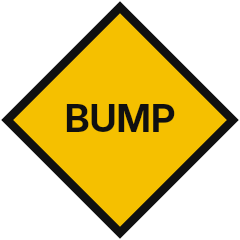
Show answer
Answer C: Slow down before reaching the rough spot and cross it at a steady, low speed
Losing speed before a sharp rise in the pavement keeps the vehicle settled, while braking or accelerating on top of it unsettles the suspension and costs grip.
-
5. How does Wisconsin define the speed range of a low-speed vehicle, also called a neighborhood electric vehicle?
Show answer
Answer A: A top attainable speed of more than 20 and not more than 25 miles per hour
Wisconsin defines a low-speed vehicle as one with a top attainable speed of more than 20 and not more than 25 miles per hour, plus a gross vehicle weight rating under 3,000 pounds.
-
6. You have parked a manual transmission car facing downhill. Which gear should you leave it in?
Show answer
Answer D: Reverse, along with the parking brake set firmly
Facing downhill the car would roll forward, so reverse gear opposes that movement while the parking brake and turned wheels back it up.
-
7. You have a steady green ball to turn left, and the oncoming traffic gets a green left arrow. What does that mean for you?
Show answer
Answer C: Oncoming vehicles will turn across your path, so you must wait
A green ball is permissive, so when the oncoming side receives a protected arrow those vehicles have priority and you must yield until they clear.
-
8. What does this sign warn a driver about?
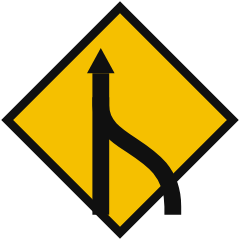
Show answer
Answer A: Traffic from another roadway will enter the same lane ahead
Two traffic streams come together into one lane beyond this point, so drivers on both roadways have to adjust speed and spacing to fit together.
-
9. Your right-turn lane shows a green arrow while the through lanes face a red ball. What does that mean?
Show answer
Answer C: Only the right turn is allowed, and it is protected while the arrow lasts
A green arrow gives a protected movement in that direction only; the red ball still stops the through traffic in the other lanes.
-
10. In which crash must the police always be notified?
Show answer
Answer D: Any crash in which somebody has been injured or killed, whatever the damage
Injury or death always makes a crash reportable, whatever the amount of vehicle damage or the opinions of the drivers.
-
11. Which sequence describes a well-made turn?
Show answer
Answer A: Signal, move into the correct lane, slow down, check, then turn
Tell others first, take your position, lose the speed before the corner, take a final look, and only then steer through the turn.
-
12. The center line beside your lane is a broken yellow line. What does it allow?
Show answer
Answer D: You may cross into the opposing lane to pass when it is safe and clear
A broken yellow center line marks a passing zone where traffic in that direction may cross into the opposing lane to pass when the way ahead is clear.
-
13. Traffic has built up behind you while you wait for a gap to turn left. How should that affect your decision?
Show answer
Answer C: It should not change it; wait for a gap that is genuinely safe
Pressure from behind does not make a small gap bigger, and rushing a left turn across traffic is a common cause of serious crashes.
-
14. The lane you are in is marked with a straight arrow and a right-turn arrow together. What does that mean?
Show answer
Answer D: Drivers in that lane may either go straight or turn right
A lane marked with two arrows serves both movements, so a driver in it may take either one.
-
15. A driver passes this sign and the signal beyond it is already showing green. What is the safest response?
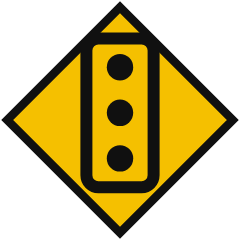
Show answer
Answer C: Ease off the accelerator and be ready to stop, because an indication that has been showing for a while is about to change
A signal that has been displaying the same indication for some time is close to changing, so arriving at a controlled speed with the brake covered is safer than accelerating to beat it.
-
16. Why is a sign reading BRIDGE ICES BEFORE ROAD worth heeding even when the road itself is merely wet?
Show answer
Answer C: Cold air passes under a bridge as well as over it
A bridge deck loses heat from below as well as above, so it can be frozen while the road on either side of it is only wet.
-
17. How can you tell a tire has reached its wear limit without measuring it?
Show answer
Answer C: The wear bars across the grooves become level with the tread
Molded bars sit at the bottom of the grooves. Once the surrounding tread has worn down to them, the tire has reached the end of its safe life.
-
18. What is the sensible way to handle a meal on a long drive?
Show answer
Answer D: Eat before you leave or stop to eat
Eating takes hands, eyes and attention, and the only version with no cost to your driving is the one that happens while the car is parked.
-
19. May you use a relative's accessible parking placard to park in a marked accessible space?
Show answer
Answer D: No, only when the placard holder is being transported in the vehicle
A placard belongs to the person, not to the car, so it is valid only when that person is being transported; using it otherwise takes a space from someone who needs it.
-
20. What is a driver being warned about here?
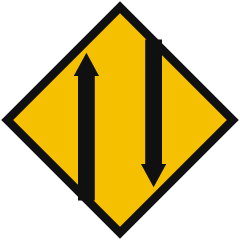
Show answer
Answer B: The pavement ahead carries vehicles traveling in the opposite direction
Beyond this point vehicles come the other way on the same pavement, which commonly happens where a one-way section or a separated stretch comes to an end.
-
21. A bicyclist is riding around a single-lane roundabout in the middle of the lane as you wait to enter. What is your duty?
Show answer
Answer C: Yield to the bicyclist just as you would to a car
A bicyclist using the roundabout is traffic like any other vehicle and has the same claim to the circulating lane.
-
22. A bicyclist ahead of you extends the left arm out with the forearm bent upward. What does that signal mean?
Show answer
Answer A: The bicyclist intends to turn right
Bicyclists use the same hand signals as drivers: left arm straight out means left, left arm bent up means right, and left arm bent down means stop or slow.
-
23. Which statement best describes what the basic speed law requires of you?
Show answer
Answer C: That you never drive faster than is reasonable and safe for the conditions
Nearly every state has a basic speed law that makes the conditions the real limit: weather, traffic, light and road surface can all require a speed well below the posted number.
-
24. A hands free phone conversation is which kind of distraction?
Show answer
Answer C: Cognitive, because your mind leaves the road
Hands free equipment removes the manual and visual parts of a call but not the mental load, and it is the mental load that makes a driver miss hazards.
-
25. What does a blood alcohol concentration of 0.08 mean for the driver of a car?
Show answer
Answer B: It is the level almost every state treats as legally intoxicated
In almost every state a driver at 0.08 or above is legally intoxicated whatever the driver seems like, but impairment starts well before that level is reached.
-
26. A small plaque mounted under this sign shows a numeral such as 2 or 3. What does that numeral report?

Show answer
Answer A: How many sets of tracks the crossing carries
The plaque states the number of tracks at that location, which is a warning that a second train may be running on another track behind the first.
-
27. A pedestrian is crossing a wide four-lane street and has reached the lanes on the far side. When may you go on?
Show answer
Answer C: Only after the person has finished crossing the roadway
Waiting until the pedestrian has finished crossing is correct in every state and removes any doubt about how much clearance your state demands.
-
28. You brake hard in a vehicle with antilock brakes and feel the pedal pulsing under your foot. What should you do?
Show answer
Answer A: Keep firm, steady pressure on the pedal and steer where you need to go
The pulsing is the system releasing and reapplying the brakes so the wheels keep rolling, which is what lets you steer while braking. Pumping the pedal defeats it.
-
29. A yellow pennant, an isosceles triangle with its long axis horizontal, is reserved for which message?
Show answer
Answer D: No passing zone
The pennant shape is used only for the no passing zone sign, which marks the point where overtaking is no longer allowed.
-
30. How do extra passengers affect a driver, especially a new one?
Show answer
Answer A: They increase the chance of distraction and of crashes
Conversation, laughter and horseplay pull a driver's attention away from the road. Crash risk for young drivers rises with each additional passenger.
-
31. A turn restriction sign at the corner shows a range of times below the symbol. What does that mean?
Show answer
Answer A: The turn is banned only during the hours shown on the sign
Times posted under a regulatory symbol set the period during which the restriction applies; outside those hours the movement is permitted.
-
32. The gates at a railroad crossing begin to come down as you approach. What must you do?
Show answer
Answer A: Stop and wait until the gates are fully raised and the lights stop flashing
Once the gates start down you must stop clear of the tracks and wait until they are fully raised and the warning lights have stopped.
-
33. You reach an uncontrolled intersection at the same moment as a vehicle approaching from your left. What should you do?
Show answer
Answer A: Proceed, but only once you see that driver slowing
You have the right of way over the vehicle on your left, but a right of way is something the other driver has to give, so confirm it before you commit.
-
34. Trees block the view along the tracks as a driver approaches this sign. What approach speed is correct?
Show answer
Answer B: Slow enough to stop before the nearest rail once a train comes into view
Where the view along the track is obstructed, the only safe speed is one that still leaves stopping distance after a train first becomes visible.
-
35. The lane you are in has a right-turn-only arrow painted on the pavement. What must you do?
Show answer
Answer C: Turn right, because a lane-use arrow is a legal requirement
Lane-use arrows painted on the pavement are regulatory markings, so a driver in that lane must travel in the direction shown.
-
36. The light turns yellow when your front wheels are already past the stop line inside the intersection. What should you do?
Show answer
Answer B: Keep going and clear the intersection without speeding up
Once you are legally in the intersection the safest and correct action is to continue through and clear it, without accelerating.
-
37. You are driving on a divided highway and see a solid yellow line along the left side of your lanes. What does it tell you?
Show answer
Answer D: It marks the left edge of the roadway for your direction
On a divided highway or a one-way roadway, the left edge of the traveled way is marked with a solid yellow line.
-
38. You realize you have turned the wrong way onto a one-way street. What should you do?
Show answer
Answer A: Pull to the right, stop, and back into the street you came from when clear
Get out of the traffic stream first: pull right and stop, then back out into the street you came from once you can see it is safe.
-
39. How long should a young child ride in a rear-facing child seat?
Show answer
Answer D: Until the child outgrows the height or the weight limit of the seat
Rear facing is the safest position and should be kept until the child reaches the top height or weight allowed by the seat.
-
40. A row of solid white triangles points toward you across your lane. What does it mark?
Show answer
Answer A: The place to yield to traffic or people ahead
A yield line of triangles shows drivers exactly where to give way, and it is used at roundabouts and at midblock crosswalks.
-
41. Besides school signing, which warning signs may also use a fluorescent yellow-green background?
Show answer
Answer C: Pedestrian and bicycle warning signs
Pedestrian crossing, bicycle and playground warning signs may use either the standard yellow or the fluorescent yellow-green background, which draws extra attention where people outside vehicles are present.
-
42. A train has just cleared a crossing that carries two sets of tracks. What should you do?
Show answer
Answer B: Wait and look both ways for a second train
A passing train hides a second train on the other track, so wait until the signals stop and you can see that both tracks are clear.
-
43. How often should the spare tire be checked?
Show answer
Answer C: Regularly, because a spare loses pressure while it sits unused
Spares lose air slowly over months, and a flat spare is useless at the moment you need it.
-
44. After completing a turn you notice your signal is still flashing. What should you do?
Show answer
Answer A: Switch it off at once, before other drivers act on it
A signal left on after a turn is a false message, and drivers waiting to pull out may move into your path because of it.
-
45. Which of these is part of preparing a vehicle for winter driving?
Show answer
Answer A: Fitting good tires and using washer fluid that will not freeze
Winter readiness means tread, battery, wipers, antifreeze and washer fluid rated for the cold, plus a reasonable amount of fuel in the tank.
-
46. You are about to open your door after parking on the traffic side of the street. What should you do first?
Show answer
Answer C: Check the mirror and look back for approaching vehicles and bicyclists before opening the door
A door opened into traffic can strike a passing bicyclist or vehicle, so you check behind you first and keep the door open no longer than necessary.
-
47. Your light is green but the traffic beyond the intersection is stopped and there is no room on the far side. What should you do?
Show answer
Answer A: Wait behind the line until you can clear the far side
Entering an intersection you cannot clear blocks the cross traffic when their signal turns green, so you wait behind the line.
-
48. The traffic signal is green, but the crossing lights on the tracks inside the intersection begin to flash. What must you do?
Show answer
Answer C: Stop clear of the tracks and wait, even though the signal is green
Active crossing warning devices outrank the green indication, so you stop short of the rails and wait until the warning stops.
-
49. You want to pass on a two-lane road where several people are walking on the narrow shoulder ahead. What should you consider?
Show answer
Answer D: There is no escape room if the pass goes wrong, so wait for a better place
A pass depends on having somewhere to go if it goes wrong, and a shoulder occupied by pedestrians removes that option for both vehicles.
-
50. Why is standing water across a road dangerous even when it looks shallow?
Show answer
Answer B: It can hide a washed out roadbed, a deep hole or a missing cover
You cannot see the surface under the water, and floods commonly wash the roadbed away or lift covers off drains.