
Wisconsin WisDOT DMV Permit Practice Test 26
- Questions50
- Correct to pass40
- Passing score80%
- Minimum age15 years
-
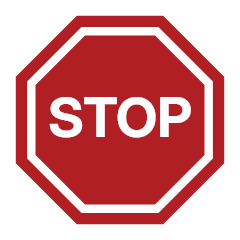
1. A stop line is painted across the pavement at this sign. Where must the vehicle come to rest?
Show answer
Answer A: Behind the stop line, with no part of the vehicle across it
The vehicle must halt behind the stop line; where no line is painted the driver stops before the crosswalk, and where there is neither, before entering the intersection.
-
2. A curb sign reads No Standing. What does it allow you to do?
Show answer
Answer B: Stop only long enough to pick up or drop off passengers
No Standing bars waiting for any purpose except the brief moment needed to let passengers in or out, which is stricter than No Parking.
-
3. About how far ahead do low beam headlights let you see on a dark road?
Show answer
Answer B: About 250 feet
Low beams light roughly 250 feet of road, and high beams roughly 350 to 500 feet, which sets the limit on a safe night speed.
-
4. A pedestrian has stepped into a crosswalk at an intersection ahead of you. What is your obligation?
Show answer
Answer C: Yield and let the pedestrian finish crossing before you proceed
Drivers must yield to pedestrians in a crosswalk, and an intersection has a legal crosswalk whether or not lines are painted on the pavement.
-
5. A deer crosses the road in front of you and disappears into the trees. What should you expect?
Show answer
Answer B: That other deer are likely to follow it across the very same stretch of road
Deer usually move in groups, so one crossing the road is a warning that more may follow.
-
6. How can you check that you are keeping a safe following distance?
Show answer
Answer A: Count at least three seconds between the vehicle ahead passing a fixed object and your reaching it
Pick a fixed roadside object, start counting when the vehicle ahead passes it and make sure at least three seconds elapse before you reach it, adding more time in poor conditions.
-
7. On what kind of Wisconsin roadway may a low-speed vehicle legally travel?
Show answer
Answer B: Local or county roads posted at 35 miles per hour or less, never a freeway or expressway
Wisconsin limits low-speed vehicles to local or county roads posted at 35 miles per hour or less, and bars them entirely from freeways, expressways, and other controlled-access highways.
-
8. Your low beams light about 250 feet of road, but at your speed you would need more than that to stop. What is that called?
Show answer
Answer D: Overdriving your headlights
When your stopping distance is longer than the stretch of road your headlights show, you cannot react to anything you finally see. Slow down until you can.
-
9. What is a marked loading zone for?
Show answer
Answer A: Loading and unloading only, not for general parking
A loading zone is reserved for actively loading or unloading goods or passengers; leaving a vehicle there for other reasons is a parking violation.
-
10. A high truck ahead of you hides the traffic signal as you approach the intersection. What should you do?
Show answer
Answer A: Drop back so you can see the signal and the truck's brake lights
Extra following distance restores your view of the signal, so you are reacting to the light yourself rather than copying the truck driver.
-
11. Another driver cuts you off and you feel your temper rising. What should you do?
Show answer
Answer A: Take a breath, drop back and let it go, because the whole trip matters more
Retaliation turns a moment of bad driving into a crash, and dropping back costs you only a few seconds.
-
12. An upward-pointing pentagon with a yellow legend and border on a blue background is used as
Show answer
Answer D: a county route marker
The pentagon serves both the school warning series and county route markers, and the blue background with yellow legend identifies the county route version.
-
13. You are about to pull out from a stop sign. Which scanning habit is correct?
Show answer
Answer A: Look to the left, then to the right, then to the left again before moving
Traffic from the left reaches you first, and a second look left catches anything that arrived while you were looking right.
-
14. What is the correct relationship between air bags and seat belts?
Show answer
Answer B: Air bags are designed to work together with seat belts, not instead of them
An air bag is a supplemental restraint that cushions one impact, while the belt keeps you in position so the bag can work and protects you in rollovers and secondary impacts.
-
15. A short driver cannot get ten inches between the chest and the steering wheel airbag. What is the answer?
Show answer
Answer D: Move the seat back and tilt the wheel downward, or fit pedal extenders
Distance from the airbag is gained by moving the seat back and aiming the wheel at the chest, using pedal extenders if the pedals are then out of reach.
-
16. When is it appropriate to use cruise control?
Show answer
Answer B: On a dry, open highway with light traffic
Cruise control suits steady conditions where you rarely need to change speed. It is a poor choice in traffic, on curves, on slippery roads or when drowsy, because it removes you from the speed decision.
-
17. You enter a work zone at night where one lane is closed and a flagger is on duty. What is the safest approach?
Show answer
Answer A: Slow early, merge before the closure and be ready to stop
Merging early at a reduced speed keeps the queue orderly and leaves you room to stop for equipment, workers or traffic that has halted ahead.
-
18. The hood of your vehicle flies open while you are driving and blocks your view. What should you do?
Show answer
Answer A: Look through the gap beneath the hood or out the side window, slow down and pull off the road
You usually still have a narrow view under the raised hood or through the side window. Use it to steer, slow gradually and get clear of traffic before securing the hood.
-
19. Apart from giving you room to stop, what else does a longer following gap do for you?
Show answer
Answer D: It widens your view of the road and the traffic ahead
Sitting further back lets you see past and around the vehicle in front, so hazards reach your eyes seconds earlier.
-
20. Where must a Wisconsin child safety seat or booster seat be installed if the vehicle has a back seat?
Show answer
Answer A: In the back seat, whenever the vehicle is equipped with one
Wisconsin law requires a child restrained in a car seat or booster seat to ride in the back seat whenever the vehicle has one.
-
21. The traffic around you is moving well above the limit on a wide highway. What should you do?
Show answer
Answer D: Keep to the limit and stay to the right, letting faster traffic pass
The limit is a legal maximum, and the safe way to differ from the traffic around you is to keep right and let it go by.
-
22. On a multi-lane street, a yield line is painted well back from an unsignalized crosswalk rather than right at it. Why?
Show answer
Answer D: So drivers in the other lanes can see the pedestrian
Setting the yield line back keeps a stopped vehicle from hiding a crossing pedestrian from drivers in the next lane, which is a common cause of these crashes.
-
23. At an intersection the signal flashes red toward you and flashes yellow toward the cross street. Who must yield?
Show answer
Answer D: You must, because the flashing red faces your road
A flashing red means stop and yield like a stop sign, while a flashing yellow lets the other road proceed with caution.
-
24. A sign warns that your exit leaves from the left side of the freeway. What should you do?
Show answer
Answer D: Move into the left lane in good time before you reach the exit
Left-hand exits are unusual, which is exactly why they are signed well in advance and why the lane changes should be finished early.
-
25. Your light turns green, but a vehicle is still in the middle of the intersection. What should you do?
Show answer
Answer D: Wait until the intersection is clear before you move ahead
A green light means go only when the way is clear. Drivers already inside the intersection must be allowed to finish crossing.
-
26. What do flashing yellow lights on a school bus mean?
Show answer
Answer A: The bus is about to stop to load or unload, so prepare to stop
The amber lights are the warning phase that comes before the red lights and the stop arm, so drivers should slow down and get ready to stop.
-
27. A yellow sign reading DEAD END is posted at the entrance to a street. What does it mean?
Show answer
Answer D: The street ends and there is no way through
A dead end street stops at its far end, so a driver who enters must come back out the same way.
-
28. On a rural two-lane road you pass small blue signs, each naming one business with an arrow and a distance. What are they?
Show answer
Answer D: Tourist-oriented directional signs for traveler businesses
Tourist-oriented directional signs carry a white legend on blue and are used on rural conventional roads to guide travelers to eligible businesses.
-
29. You are entering a marked work zone. What should you expect?
Show answer
Answer B: A reduced posted speed, narrowed or shifted lanes, and traffic that may stop suddenly
Work zones change the geometry of the road and can bring traffic to a halt without warning, so the posted work zone speed and increased following distance both apply.
-
30. Which part of the space around your vehicle can you control best?
Show answer
Answer A: The space ahead of you
You choose your own following distance, so the gap in front is the space you truly control and the one that gives you time to react.
-
31. You are descending a long steep grade with a loaded truck close behind you. What should you do?
Show answer
Answer A: Hold a steady speed and let it pass when it can
Gravity pushes a loaded truck downhill and it cannot slow quickly, so give it a predictable speed and room to get by rather than braking in front of it.
-
32. A separate right-turn lane leads onto the cross street and carries a yield sign. What does it require?
Show answer
Answer D: Slowing and giving way to traffic and people, stopping if needed
A yield requires you to slow, give way to traffic in the lane you are joining and to pedestrians, and stop only if that is what safety demands.
-
33. You have a green light and are turning right. Pedestrians are stepping off the curb into the crosswalk you are about to cross. What should you do?
Show answer
Answer B: Wait and let them cross before completing your turn
A green light does not release a turning driver from yielding to pedestrians already in the crosswalk of the street being entered.
-
34. The red oil pressure warning light comes on while you are driving. What should you do?
Show answer
Answer C: Pull over safely as soon as possible and shut off the engine
Loss of oil pressure means the engine is no longer being lubricated and can be destroyed within minutes. Stop, shut down and check before restarting.
-
35. You have just been involved in a crash on a city street. Which sequence of first steps is correct?
Show answer
Answer A: Stop where you are, check everyone for injuries, and then make the scene safe
You are required to stop, and the first priority at the scene is people, followed by preventing a second collision.
-
36. You reach a one-lane bridge and a vehicle is already partway across it coming toward you. What should you do?
Show answer
Answer D: Stop before the bridge and let it come through
A vehicle already on a one-lane bridge has the right of way, and the driver who has not yet entered waits at the approach.
-
37. How much moving water is generally enough to float and carry away most passenger vehicles?
Show answer
Answer D: About one foot
About a foot of moving water will float most cars, and even less will stall an engine. That is why the rule is to turn around instead of judging the depth.
-
38. What makes a driver a habitual traffic offender in Wisconsin?
Show answer
Answer D: Four or more major violations, or 12 or more minor violations, within five years
Wisconsin treats a driver as a habitual traffic offender after four or more major violations or 12 or more minor violations within five years, and revokes the privilege for five years.
-
39. Which combination best reduces the chance of hydroplaning?
Show answer
Answer D: Good tread depth, correct tire pressure and lower speed in the rain
Tread channels water away, correct pressure keeps the tire's shape, and lower speed gives the tire time to push water aside. Hydroplaning can begin at surprisingly modest speeds.
-
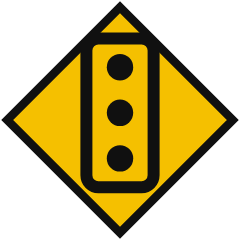
40. What does this sign require of the driver?
Show answer
Answer D: Reducing speed and being ready to stop at the intersection ahead
The advance notice asks the driver to slow and be ready to stop, while whether a stop is actually needed depends on the indication displayed on arrival.
-
41. A center lane is bordered by a solid yellow line on the outside and a broken yellow line on the inside, with turn arrows painted inside it. What is that lane for?
Show answer
Answer C: Left turns made by traffic traveling in either direction
That marking pattern identifies a two-way left-turn lane, which drivers approaching from both directions may use to prepare for a left turn.
-
42. You want to stop briefly and the only space is in the travel lane alongside a vehicle already parked at the curb. Is this allowed?
Show answer
Answer D: No, double parking blocks a travel lane and is prohibited
Stopping in the roadway beside a parked vehicle removes a lane from traffic and forces other drivers to swerve around you, which is why double parking is prohibited.
-
43. On a narrow two-lane road a line of vehicles has built up behind you. What is the safe and courteous action?
Show answer
Answer D: Pull into a turnout or a safe wide spot and let them go by
A slow vehicle holding up a queue invites risky passing; using a turnout clears the road without anyone having to take a chance.
-
44. You have just had bad news and you feel very upset. What should you do?
Show answer
Answer B: Wait until you have calmed down, or else let somebody else drive
Strong emotion takes attention away from the road as surely as alcohol or fatigue, so it is a reason not to drive yet.
-
45. A city transit bus ahead of you has stopped at the curb with its passenger door open. What does the law require of you?
Show answer
Answer D: Nothing special, but pass slowly and watch for people
The mandatory stop applies to a school bus showing red flashing lights, not to a transit bus, though a careful driver still slows for crossing passengers.
-
46. Two lanes at the corner are marked for right turns. What does that require of you?
Show answer
Answer A: Keep your own lane through the turn and into the matching new lane
Dual turn lanes work only if each vehicle stays in its own lane all the way round and finishes in the corresponding lane of the new street.
-
47. Why are pedestrians and cyclists a special risk on unlit streets at night?
Show answer
Answer A: Dark clothing can make them invisible until they are very close
A person in dark clothing reflects almost no light and may not appear until they are inside your stopping distance, so cut your speed where people may be about.
-
48. Why is heavy braking a poor idea while two wheels are still on a soft shoulder?
Show answer
Answer B: The two sides have different grip, so the vehicle can pull sharply
With one pair of wheels on pavement and the other on loose material, hard braking slows one side more than the other and swings the vehicle around.
-
49. A yellow lamp flashes above a warning sign at a sharp curve. What does it ask of a driver?
Show answer
Answer D: Slow down and pass the point with extra care
A warning beacon draws attention to the sign it is mounted with, and the message of the sign is what the driver must act on.
-
50. Two solid white lines are painted between your lane and the lane beside it. What do they mean?
Show answer
Answer D: Crossing from one lane to the other is prohibited
Double solid white lines separate lanes of traffic going the same way and may not be crossed.