
Wisconsin WisDOT DMV Motorcycle Practice Test 13
- Questions25
- Correct to pass20
- Passing score80%
- Minimum age16 years
-
1. A school crossing guard steps into the roadway and holds up a stop paddle. What must you do?
Show answer
Answer D: Stop and stay stopped until the guard and the children have left the road
A crossing guard directs traffic with legal authority; you must remain stopped until both the guard and the children are clear of the roadway.
-
2. You are about to pass a bicyclist on a narrow two-lane road. What is the correct way to do it?
Show answer
Answer A: Wait for a clear gap and move well left, giving the rider wide space
Pass a cyclist as you would a car: wait for clear road, change lane position to leave generous clearance, and return only when the rider is well behind you.
-
3. What are painted curb markings mainly used for?
Show answer
Answer D: Conveying parking and stopping regulations
Colored curbs tell drivers where waiting or parking is restricted, and because the exact color meanings are set locally a driver should also read the posted signs.
-
4. What color and visibility distance does Wisconsin require of a motorcycle's brake light?
Show answer
Answer A: Constant red or amber, visible for at least 300 feet
Wisconsin requires a motorcycle brake light to show a constant red or amber light, visible from at least 300 feet.
-
5. What causes the side to side motion a rider feels when crossing a steel grid deck or rain grooves?
Show answer
Answer C: The tires following the ridges and grooves, which is normal and harmless
The tread follows the pattern in the surface, which produces a wandering feel. The motorcycle is not out of control, so relax on the bars and hold your speed.
-
6. Why does even a small reduction in speed matter so much where people are walking?
Show answer
Answer D: Because a pedestrian struck at a lower speed is far more likely to survive
The chance that a pedestrian survives falls steeply as impact speed rises, so a few miles per hour can decide the outcome.
-
7. Two drivers each have three drinks, one over three hours and one in half an hour. What is the difference?
Show answer
Answer C: The fast drinker reaches a higher peak level
The liver removes alcohol at a steady rate, so drinking faster than the body can clear it pushes the blood alcohol level much higher.
-
8. What is the main danger of grabbing the front brake lever abruptly?
Show answer
Answer D: The front wheel can lock, and a locked wheel cannot steer or balance
The front brake must be squeezed progressively so that weight transfers onto the front tire before full braking force is asked of it.
-
9. Why is the front brake avoided during a very slow, tightly leaned turn?
Show answer
Answer D: It can upset the balance of a leaned machine and drop it at low speed
At low speed and full lock there is little momentum holding the motorcycle up, and the sudden weight shift from the front brake easily topples it.
-
10. A school sign paired with a plaque showing a diagonal downward-pointing arrow is installed
Show answer
Answer D: at the school crossing itself, or as close to it as possible
The diagonal downward arrow points at the crossing, so this assembly is placed at the crossing location rather than in advance of it.
-
11. The front tire suddenly loses air while you are riding. What should you do?
Show answer
Answer D: Hold the bars firmly, ease off the throttle and slow using the rear brake
A deflating front tire makes the steering feel heavy, so the rider keeps a straight line, avoids the affected wheel when braking and eases off the road.
-
12. What does the traffic law actually say about the right of way?
Show answer
Answer B: It says who must yield; no driver is ever entitled to take the right of way
The law describes who must yield. Right of way is something you give; insisting on it when another driver does not yield causes crashes.
-
13. Snow has covered the pavement markings on a two-lane road. How should a driver judge lane position?
Show answer
Answer B: By the tracks of other traffic and the roadside features
With the markings hidden, ruts left by earlier traffic, signs, poles and the line of the shoulder are the best clues to where the lane runs.
-
14. A set of reversible express lanes is closed off with gates and signs while it runs the other way. What must you never do?
Show answer
Answer C: Enter past a closed gate or a sign showing the lanes are closed
When reversible lanes are closed they may already be carrying traffic in the opposite direction, so entering past a gate can put you head-on into that traffic.
-
15. A white arrow painted in your lane points only to the right, and a sign above the lane shows the same movement. What must you do?
Show answer
Answer C: Turn right from that lane
Pavement arrows used with lane-use signs are regulatory, so a driver occupying that lane must make the movement shown.
-
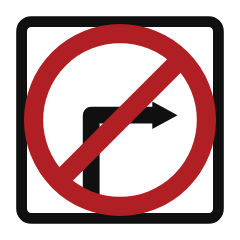
16. A driver stopped at a red signal wants to turn right and this sign is posted at the corner. What is permitted?
Show answer
Answer A: Nothing: the turn is barred whether the signal is red or green
The restriction works independently of the signal, so the usual permission to turn right after stopping at a red light does not exist where this sign is posted.
-
17. How long should a glance at a mirror or an instrument take?
Show answer
Answer A: A brief glance of about a second, returning your eyes to the road at once
Checks should be quick flicks of the eyes. At highway speed, a few seconds with your eyes off the road covers a distance long enough for a hazard to appear.
-
18. You are behind a slow vehicle on a two-lane road and a marked passing lane begins a mile ahead. What is the sensible choice?
Show answer
Answer D: Wait for the passing lane rather than using the opposing lane
A passing lane lets you overtake without ever entering the lane used by oncoming traffic, which is far safer than a pass a minute earlier.
-
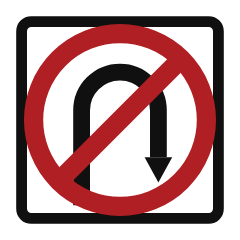
19. A driver who wants to reverse direction arrives at this sign. What is allowed?
Show answer
Answer C: Going on and reversing direction only where the maneuver is permitted
The restriction removes that maneuver at that spot entirely, so the driver has to continue and turn the vehicle around at a place where it is not prohibited.
-
20. Which federal standard must a motorcycle helmet meet to be sold for on-road use in the United States?
Show answer
Answer B: FMVSS No. 218
Federal Motor Vehicle Safety Standard No. 218 sets the impact, penetration and retention requirements for motorcycle helmets sold in the United States.
-
21. The driver of a slow farm vehicle moves partly onto the shoulder and waves you past. Who is responsible for the pass?
Show answer
Answer A: You are, so pass only if you can see that the road is clear
A courtesy wave is not a traffic control, and the driver who changes lanes is the one answerable for the maneuver.
-
22. How does driving on overinflated tires affect the vehicle?
Show answer
Answer D: It gives a harsher ride and a smaller contact patch
An overinflated tire bulges in the middle, so less rubber touches the road, grip suffers and the ride becomes hard. The center of the tread wears first.
-
23. What does a shaft final drive need checked before a ride?
Show answer
Answer D: The fluid level in the final drive housing, and any sign of leaks
A shaft drive runs in its own oil bath, so the pre-ride check is the fluid level and any leak around the housing seals rather than tension or slack.
-
24. A yellow pennant, an isosceles triangle with its long axis horizontal, is reserved for which message?
Show answer
Answer D: No passing zone
The pennant shape is used only for the no passing zone sign, which marks the point where overtaking is no longer allowed.
-
25. Does using a hands free device remove the risk of distraction?
Show answer
Answer A: No, the conversation still takes attention away from driving
Hands free equipment removes the manual part of the distraction but not the mental part, and a driver deep in conversation can look straight at a hazard without registering it.