
Wisconsin WisDOT DMV Motorcycle Practice Test 31
- Questions25
- Correct to pass20
- Passing score80%
- Minimum age16 years
-
1. An upward-pointing pentagon with a yellow legend and border on a blue background is used as
Show answer
Answer D: a county route marker
The pentagon serves both the school warning series and county route markers, and the blue background with yellow legend identifies the county route version.
-
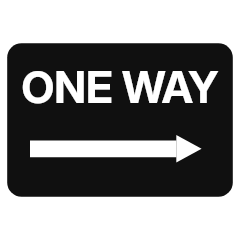
2. Where are signs of this kind placed at an intersection?
Show answer
Answer C: At the near right and far left corners, facing drivers on the intersecting street
They are installed at the corners of the intersecting street so that a driver about to turn in sees the restriction before committing to the turn.
-
3. Which of the four blind spots around a tractor-trailer is the largest?
Show answer
Answer A: The one on the right side of the truck
A truck has no-zones on all four sides, and the right-side blind spot is the largest because it runs back along the trailer and reaches across more than one lane.
-
4. You back into an unattended parked car in a lot and cause visible damage. What must you do?
Show answer
Answer A: Try to find the owner, or leave a note with your name and contact details, and report the crash
Hitting an unattended vehicle carries the same duties as any crash. Leaving without identifying yourself is a hit-and-run offense.
-
5. What is the most common cause of rear-end collisions?
Show answer
Answer C: Following too closely to stop in time
A driver who leaves too little space has no room to perceive, react and brake when the vehicle ahead slows, which is why space management prevents rear-end crashes.
-
6. Another driver is behaving aggressively toward you. What should you do?
Show answer
Answer D: Avoid eye contact, give them room to go on their way and do not respond to provocation
Responding to an aggressive driver escalates the conflict, while creating distance and refusing to engage takes you out of the situation. Report serious threats once you can do so safely.
-
7. You must park on soft ground or on asphalt softened by heat. What should you do about the sidestand?
Show answer
Answer A: Put a flat, firm object under the stand to spread the load
A sidestand concentrates the weight of the machine onto a very small area, and on soft ground it sinks in until the motorcycle falls over.
-
8. You have a green light and are turning right. Pedestrians are stepping off the curb into the crosswalk you are about to cross. What should you do?
Show answer
Answer B: Wait and let them cross before completing your turn
A green light does not release a turning driver from yielding to pedestrians already in the crosswalk of the street being entered.
-
9. When is a driver or rider most likely to need hand and arm signals instead of the vehicle turn signal lamps?
Show answer
Answer D: When the lamps have failed or cannot be seen because of glare or a load
Hand and arm signals replace or reinforce the lamps whenever the lamps do not work or cannot be seen clearly by other road users.
-
10. Compared with dry pavement, how much room does a vehicle need to stop on packed snow?
Show answer
Answer D: Several times as much
Grip on packed snow is a fraction of that on dry pavement, so stopping distance grows several times over. Antilock brakes help you steer, not stop shorter.
-
11. It is very hot and a rider is tempted to take off the riding jacket. Why can that make the heat worse?
Show answer
Answer C: A bare arm in hot moving air loses fluid fast and burns in the sun
In hot, dry air a covering layer slows the evaporation of sweat and blocks the sun, so ventilated gear can keep a rider cooler and better hydrated than bare skin.
-
12. The driver ahead of you is straddling the lane line and is not signaling. How should you respond?
Show answer
Answer B: Stay back until you can see which lane that driver will take
A vehicle astride the line could move either way, so the only safe place is behind it where both possibilities are still covered.
-
13. A black on white regulatory sign at an intersection reads NO TURNS. What may a driver do there?
Show answer
Answer B: Only continue straight through the intersection
The NO TURNS sign bans turns in every direction at that intersection, so the only lawful movement from that approach is straight through.
-
14. How far back must a Wisconsin motorcycle's rear view mirror show the roadway?
Show answer
Answer A: At least 200 feet
Wisconsin requires a motorcycle's rear view mirror to show a rear view of the roadway for at least 200 feet.
-
15. Which of these is an early warning that you are too tired to keep driving?
Show answer
Answer C: Not remembering the last few miles you drove
Memory gaps, repeated yawning, heavy eyelids and drifting are the body signaling that sleep is winning, and they mean stop rather than push on.
-
16. You are on a two-lane road where a broken yellow line runs on your side of the center. What does that pattern allow?
Show answer
Answer C: Passing when the way ahead is clear and it is otherwise legal
A broken yellow center line marks a stretch where passing is permitted for traffic on that side when it can be completed safely.
-
17. A driver behind you on a two-lane road clearly wants to pass. Why should you not wave that driver past?
Show answer
Answer B: You cannot see the whole road ahead for them and they may rely on your signal
Waving another driver out invites them to trust your judgment of a road you cannot see well enough, and the decision to pass belongs to the driver making it.
-
18. Smoke and flames appear from the engine compartment after you stop. What should you do?
Show answer
Answer A: Get everyone well away from the vehicle first, and then call the fire service
A vehicle fire can spread within seconds, so people come out first and firefighting is left to the fire service.
-
19. The center line beside your lane is a broken yellow line. What does it allow?
Show answer
Answer D: You may cross into the opposing lane to pass when it is safe and clear
A broken yellow center line marks a passing zone where traffic in that direction may cross into the opposing lane to pass when the way ahead is clear.
-
20. If you must abandon a vehicle stuck on the tracks with a train coming, why do you move toward the train and away at an angle?
Show answer
Answer D: Because debris from the impact is thrown forward, away from the train
A train pushes wreckage down the track ahead of it, so walking toward the train and off to the side keeps you out of the debris path.
-
21. What does black ice usually look like from the driver seat?
Show answer
Answer C: A patch of pavement that simply looks wet or slightly glossy
Black ice is clear, so you see the dark road through it and read it as a wet patch. In freezing weather, treat any wet looking patch as ice.
-
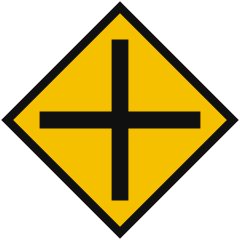
22. What should a driver expect a short distance beyond this sign?
Show answer
Answer C: Another road crossing the one being traveled
Traffic may enter or cross from either side at the intersection ahead, so the driver should ease off, cover the brake and check both approaches.
-
23. Where should a rider in the middle of a group direct their attention?
Show answer
Answer A: Well ahead through the group and around it, not just at the rider in front
Watching only the machine ahead hides the traffic and hazards further up the road, and it leaves the rider reacting late to everything the group meets.
-
24. Why should a rider avoid painting a helmet or cleaning it with strong solvents?
Show answer
Answer D: Chemicals can weaken the shell and the liner without showing it
Solvents and some paints attack the shell and the foam, so use mild soap and water and follow the maker's instructions to keep the helmet's protection intact.
-
25. The gates at a railroad crossing begin to come down as you approach. What must you do?
Show answer
Answer A: Stop and wait until the gates are fully raised and the lights stop flashing
Once the gates start down you must stop clear of the tracks and wait until they are fully raised and the warning lights have stopped.