
Wisconsin WisDOT DMV Motorcycle Practice Test 46
- Questions25
- Correct to pass20
- Passing score80%
- Minimum age16 years
-
1. You are waiting to turn left at a solid green light with no green arrow. Oncoming traffic is approaching. What should you do?
Show answer
Answer A: Yield to the oncoming traffic and turn only when there is a safe gap
A solid green light permits the left turn but does not protect it, so you must yield to oncoming vehicles and to pedestrians before turning.
-
2. A square sign with a red field, a wide white horizontal bar and the words DO NOT ENTER tells a driver that
Show answer
Answer B: the roadway ahead must not be entered from that point
The do not enter sign is posted at the end of a one-way roadway or ramp to keep traffic from driving into it against the flow.
-
3. The temperature gauge climbs toward the red while you sit in slow moving traffic. What should you do?
Show answer
Answer A: Get out of the traffic as soon as it is safe and let the engine cool
A stationary motorcycle gets almost no airflow through the engine or radiator, so the cure is to stop creeping along in traffic and let it cool.
-
4. A yellow sign reads SOFT SHOULDER. What is it telling you?
Show answer
Answer C: The shoulder may not carry the weight of a vehicle
A soft shoulder is unpaved and can let a wheel sink, so a driver who leaves the pavement there may lose control or become stuck.
-
5. You are driving through a long curve on a road with two lanes in your direction. What is correct?
Show answer
Answer A: Stay within your own lane all the way through, adjusting speed before you enter
Wandering out of your lane in a curve puts you into the path of a vehicle you cannot see, and the slowing belongs before the curve rather than in it.
-
6. A sign on a long downgrade points to a runaway vehicle ramp. What is that ramp for?
Show answer
Answer C: Trucks that have lost braking ability on the grade
A runaway ramp is an escape lane of loose material that stops a heavy vehicle whose brakes have overheated or failed, so it must always be left clear.
-
7. A freeway sign reads BUSES ONLY ON SHOULDER 6 AM TO 9 AM. Who may drive on the shoulder then?
Show answer
Answer A: Only the vehicles named on the sign, during the hours shown
Shoulder running is granted by the sign to the class of vehicle and the hours the sign names, and it does not turn the shoulder into a general travel lane.
-
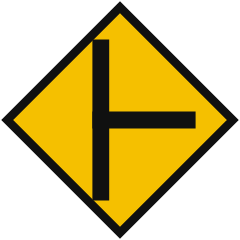
8. What condition does this sign warn a driver about?
Show answer
Answer B: Another road joins the road being traveled, from one side
It announces a side road entering the main roadway, so the driver should expect vehicles waiting to pull out and other vehicles slowing to turn in.
-
9. A sign warns that the right lane ends ahead, and traffic is still flowing freely. What should you do if you are in that lane?
Show answer
Answer C: Signal, adjust your speed and move left in good time before the lane ends
When traffic is moving freely there is room to merge early and smoothly, which avoids the last-second lane change at the closure point.
-
10. Where should a rider with a disabled motorcycle try to stop?
Show answer
Answer D: Well clear of the traffic lanes, off the shoulder where there is room
Getting completely away from moving traffic protects the stopped rider and anyone helping, and a shoulder alone is not a safe place to work on a machine.
-
11. What limits how much weight a motorcycle can carry?
Show answer
Answer A: The load limit given by the manufacturer for that machine
The manufacturer's figure covers the rider, the passenger and everything carried, and going over it overloads the tires, the brakes and the suspension.
-
12. You are stopped in a line of traffic waiting at a red light. What is the safest way to wait?
Show answer
Answer A: Stay in first gear, keep watching the mirrors and leave a way out
A vehicle approaching from behind may not stop in time, and staying in gear with a gap ahead lets the rider move out of the way.
-
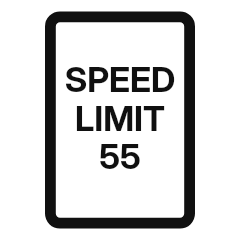
13. A driver passes this sign on an open road. Over what stretch does the figure it sets stay in force?
Show answer
Answer A: From the sign onward, in every lane, until another sign sets a different figure
The figure governs the road from the sign onward and binds every lane, and it stays in force until a later sign sets a different one.
-
14. Besides the certification label, what does a novelty helmet typically lack?
Show answer
Answer B: A thick, firm liner of impact absorbing foam under the shell
The energy absorbing layer is what makes a helmet work, and a novelty shell has little or none of it, so it offers almost no protection in a crash.
-
15. A separate right-turn lane leads onto the cross street and carries a yield sign. What does it require?
Show answer
Answer D: Slowing and giving way to traffic and people, stopping if needed
A yield requires you to slow, give way to traffic in the lane you are joining and to pedestrians, and stop only if that is what safety demands.
-
16. Your vehicle is burning at the roadside. How far away should everyone keep?
Show answer
Answer D: At least a hundred feet away from the vehicle and upwind, out of the drifting smoke
Burning vehicles give off toxic smoke and parts such as tires and struts can burst, so keep a long distance and stay upwind.
-
17. Why should riding gloves fit snugly?
Show answer
Answer C: So loose material does not dull your feel for the controls
Bunched or baggy material gets between your hand and the grip, so a close fitting glove keeps the feel for the throttle, clutch and brake lever.
-
18. A pedestrian is crossing a wide four-lane street and has reached the lanes on the far side. When may you go on?
Show answer
Answer C: Only after the person has finished crossing the roadway
Waiting until the pedestrian has finished crossing is correct in every state and removes any doubt about how much clearance your state demands.
-
19. You are moving at walking pace through a crowded parking area. Which combination gives the steadiest control?
Show answer
Answer B: Steady throttle, the clutch held in the friction zone and light rear brake
Slipping the clutch in the friction zone against a steady throttle and a light drag of rear brake keeps power smooth and the machine stable below walking speed.
-
20. When should a passenger get on the motorcycle?
Show answer
Answer D: After the engine has been started and the operator is ready
Mounting after the engine is running and the operator is settled keeps the motorcycle stable and spares the operator a long balancing act with the extra weight aboard.
-
21. The crossing gates begin to lower while your vehicle is still on the railroad tracks. What should you do?
Show answer
Answer B: Keep going forward and push through the gate if it should block your way
Gates are made to break away, and driving forward off the tracks is far safer than staying between them or backing up.
-
22. A driver is following you far too closely and you have a turn coming up. How should you slow down for it?
Show answer
Answer B: Signal early and slow gradually well before the turn
Early signals and gentle braking give a tailgater the time and distance they have failed to leave for themselves.
-
23. Your group arrives at a stop sign at a busy crossroad. How should each rider treat it?
Show answer
Answer C: Stop and pull out only when there is an adequate gap of your own
Following the machine ahead through a junction without looking is a common cause of group crashes, because the gap the leader used has already closed.
-
24. Where is a road work ahead sign placed?
Show answer
Answer B: In advance of the work space or detour, so drivers are warned before reaching it
Advance warning signs are placed upstream of the work space or detour so that drivers have time to slow down and change lanes before reaching the activity.
-
25. What makes a left turn protected rather than permissive?
Show answer
Answer B: Oncoming traffic is held by a red signal while you have a green arrow
A protected turn is one where the conflicting movements are stopped by their own signal, which is what the green arrow indicates.