
Wisconsin WisDOT DMV Motorcycle Practice Test 17
- Questions25
- Correct to pass20
- Passing score80%
- Minimum age16 years
-
1. A bag strapped to the back of your motorcycle works loose and starts to shift as you ride. What should you do?
Show answer
Answer C: Slow smoothly, pull off the road, and secure the load before riding on
A load that moves changes the balance of the motorcycle and can foul a wheel or the chain, so stop as soon as you safely can and fasten it properly.
-
2. You realize your tires are running on ice. Which set of inputs is safest?
Show answer
Answer C: Gentle steering, no sudden braking, and no sudden acceleration
Whatever grip is left is used up at once by any sudden input, so every movement of wheel, brake and accelerator must be slow and small.
-
3. You are waiting to enter a two-lane roundabout and traffic is circulating in both lanes. What must you do?
Show answer
Answer A: Yield to traffic in both circulating lanes before you enter
Every entry to a roundabout is a yield point, and at a two-lane roundabout that means giving way to vehicles in either circulating lane.
-
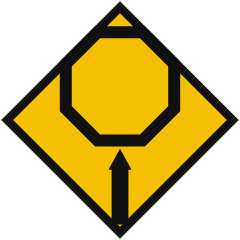
4. What is the driver expected to do after passing this sign?
Show answer
Answer A: Begin slowing so that a complete stop can be made at the intersection ahead
It is used where the control at the intersection stays hidden until late, so braking should begin here rather than at the stop line.
-
5. Why is parking against the flow of traffic dangerous even when nobody complains?
Show answer
Answer D: Because you had to cross traffic to get there and must cross again to leave
Parking on the wrong side means driving against traffic at both ends of the stop, and your reflectors and lights face the wrong way while you are there.
-
6. A traffic signal separates you from the rest of your group. What should you do?
Show answer
Answer B: Continue at a safe and legal pace and rejoin the group farther along
Staying with a group never justifies breaking a traffic law, so a separated rider proceeds normally and the group regroups at a planned point.
-
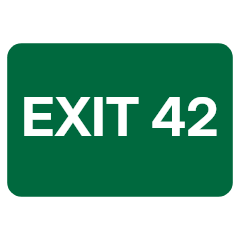
7. A driver in the left lane of a freeway realizes only when level with this sign that the ramp beside it is the one they need. What is the correct action?
Show answer
Answer A: Carry on to the next interchange and turn back from there
There is no safe way back to a ramp once it has been reached from the wrong lane, so the driver keeps going to the next interchange, where the ramps are built for that movement.
-
8. A regulatory sign posted at the start of a road reads LENGTH LIMIT 30 FEET. What does it control?
Show answer
Answer B: The overall length of vehicle allowed on that road
Some states post a length limit where tight curves or narrow structures lie ahead; it bars vehicles or combinations longer than the figure shown from using that road.
-
9. Windblown sand has collected across the pavement at a rural intersection where you must stop. How should you handle the stop?
Show answer
Answer A: Do your braking on clean pavement before the sand, then roll across upright
Sand acts like ball bearings under the tires, so finish your braking on the clean surface ahead of it and cross the loose patch upright with no sudden inputs.
-
10. How can a rider check the action of the front suspension while the motorcycle is stationary?
Show answer
Answer D: Hold the front brake on and push down on the bars to feel the forks move and return
Compressing the forks against the front brake shows whether they move smoothly and return without binding, sticking or making noise.
-
11. Why does a rider on an unfaired motorcycle tire faster on a long highway ride than a driver would?
Show answer
Answer A: Constant wind pressure and noise drain energy hour after hour
Fighting wind pressure and enduring wind noise for hours is physically tiring, which is why wind protection and regular breaks matter on long rides.
-
12. Where is a U-turn generally the most reasonable choice?
Show answer
Answer B: At an intersection where it is permitted and you can see well both ways
A U-turn needs a legal place and a long clear view in both directions, which is why a permitted intersection with open sight lines is the usual choice.
-
13. You feel drowsy, so you open a window and turn the radio up. What does that achieve?
Show answer
Answer B: Very little, because the drowsiness comes back
Cold air and loud music are not sleep, so the alerting effect lasts a minute or two and the driver is soon just as sleepy and closer to a lapse.
-
14. At a freeway exit, the paved triangle between the ramp and the through lanes is filled with diagonal white lines. What do they mean?
Show answer
Answer A: Stay out of that area, because it is not meant to be driven on
Chevron and diagonal markings fill paved areas that traffic is not intended to use, so drivers should keep out of them.
-
15. Comparing a first alcohol-related conviction to a second, how does the waiting period for a Wisconsin occupational license differ?
Show answer
Answer C: A first conviction allows immediate eligibility, while a second imposes a 45-day wait
Wisconsin allows immediate eligibility for an occupational license after a first alcohol conviction, but imposes a 45-day waiting period after a second.
-
16. A motorcycle in your group develops a mechanical problem on a busy highway. What is the best response?
Show answer
Answer C: Signal the group off at the next exit or wide, safe pull off area
A narrow shoulder beside fast traffic is a dangerous place to gather, so the group moves on to a spot where every machine is well clear of the roadway.
-
17. Your phone is in a mount on the dashboard rather than in your hand. What is true?
Show answer
Answer B: It still takes your eyes and mind off the road
A mount solves the hand problem but not the eye or the mind problem, and reading or tapping a mounted screen costs the same seconds of attention.
-
18. You enter a work zone at night where one lane is closed and a flagger is on duty. What is the safest approach?
Show answer
Answer A: Slow early, merge before the closure and be ready to stop
Merging early at a reduced speed keeps the queue orderly and leaves you room to stop for equipment, workers or traffic that has halted ahead.
-
19. About how far does a vehicle travel in one second at 60 mph?
Show answer
Answer A: About 88 feet
At 60 mph you cover about 88 feet every second, which is why a glance of only two or three seconds means driving the length of several vehicles blind.
-
20. What is the right speed for a normal right turn at a city corner?
Show answer
Answer C: Slow enough to hold your lane and stop for a pedestrian
A city right turn is tight and crosses a crosswalk, so the correct speed is one that keeps you inside your lane and still allows a stop.
-
21. At what property damage amount does Wisconsin require a crash to be reported, and does that threshold change for government-owned property?
Show answer
Answer A: $1,000 or more for private vehicles or property, but only $200 or more for government-owned property
Wisconsin requires a crash report when damage reaches $1,000 or more to a person's vehicle or property, but sets a lower $200 threshold for damage to government-owned property.
-
22. The vehicle in front of you has stopped and is waiting to turn left, and there is a paved shoulder to the right. May you use it to get by?
Show answer
Answer D: No, in most states a pass may not be made by leaving the paved travel lanes
Passing on the right is normally lawful only inside the marked travel lanes, and most states prohibit driving onto the shoulder to get around a turning vehicle; the few states that allow it attach strict conditions.
-
23. Why is wearing headphones over both ears a problem while driving?
Show answer
Answer D: You may not hear horns, sirens or other warning sounds
Hearing is part of your awareness of traffic. Covering both ears blocks emergency sirens, horns and the sound of an approaching vehicle you cannot yet see.
-
24. A farm implement ahead of you on a two-lane road is wider than its own lane. What should you do?
Show answer
Answer D: Hang back until you can see past it and pass only with a clear road
Wide equipment hides the road ahead and may extend farther across the center line than it appears, so the pass needs more room and a much better view.
-
25. You are on an entrance ramp merging onto a freeway. Who has to give way?
Show answer
Answer B: You must yield and fit into a gap in the traffic already on the freeway
Traffic entering a highway must yield to traffic already on it. Use the acceleration lane to match speed and merge into a gap.