
Wisconsin WisDOT DMV Motorcycle Practice Test 5
Test 5 of 6. Pick an answer for each question to see if it is right and why; your score appears at the end. You need 20 correct answers to pass, the same ratio as the real Wisconsin test.
- Questions25
- Correct to pass20
- Passing score80%
- Minimum age16 years
-
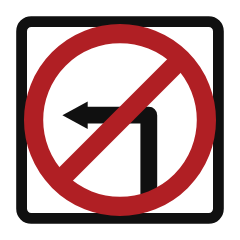
1. No plaque stating days or hours accompanies this sign at the intersection. When does the restriction apply?
Show answer
Answer D: At all times, since nothing limits it to particular periods
A regulatory restriction runs continuously unless a supplemental plaque states the days or hours during which it applies.
-
2. A clutch cable adjusted with no free play at all causes what problem?
Show answer
Answer B: The clutch may slip and never fully engage
Without a small amount of slack the release mechanism keeps a light load on the plates, so they slip instead of transmitting full power.
-
3. While a Wisconsin driver is under a court-ordered ignition interlock requirement, what BAC level are they barred from exceeding just to start the vehicle?
Show answer
Answer C: 0.02
A Wisconsin driver operating under an ignition interlock order may not have a BAC above 0.02, well below the standard adult limit.
-
4. A flagger in a work zone turns a paddle so that the red octagonal face reading STOP is toward you. What must you do?
Show answer
Answer A: Stop completely and wait for the flagger to signal you forward
The STOP face of a flagger paddle requires a complete stop, and you may move again only when the flagger directs you to.
-
5. You are driving along a street lined with parked cars. What should you watch for?
Show answer
Answer B: Doors opening, vehicles pulling out and pedestrians stepping from between cars
Parked cars hide people and can move without warning. Keep as much space from them as you safely can and cover the brake.
-
6. After a reportable Wisconsin crash, whose liability insurance information must be submitted to the state?
Show answer
Answer B: Everyone involved in the crash, regardless of fault
Wisconsin's insurance reporting program requires complete liability insurance information from everyone involved in a reportable crash, regardless of who was at fault.
-
7. How far must a Wisconsin motorcycle's headlight be able to reveal a person or object, and when must it operate?
Show answer
Answer A: 350 feet, and it must operate both day and night
Wisconsin requires a motorcycle headlight to be a white light bright enough to reveal a person or object 350 feet away, operating during both day and night.
-
8. Unless a sign posts otherwise, what is the Wisconsin speed limit in a residential area?
Show answer
Answer B: 25 miles per hour
Wisconsin sets 25 miles per hour as the residential speed limit when no other limit is posted.
-
9. What does the Wisconsin absolute sobriety rule require of a driver under 21?
Show answer
Answer D: No alcohol at all in the system
Wisconsin requires absolute sobriety of drivers under 21, so any amount of alcohol in the system while driving is illegal.
-
10. What does Wisconsin law say about eye protection worn during hours of darkness?
Show answer
Answer C: It may not be tinted or darkened
Wisconsin law states that eye protection worn during hours of darkness may not be tinted or darkened, although photosensitive prescription lenses are accepted.
-
11. A raised area crosses the roadway and carries a series of white markings on its face. What are those markings for?
Show answer
Answer A: To make the hump visible so drivers slow for it
Speed hump markings warn drivers that the pavement rises, which matters most at night or when the hump is in shadow.
-
12. You have just returned to your own lane after passing. Why should you not slow down straight away?
Show answer
Answer A: The vehicle you passed is close behind and needs room to stop
Returning and then braking leaves the driver you just overtook with almost no following distance, which is how a pass turns into a rear-end collision.
-
13. Besides police, fire, and ambulance vehicles, what other stopped vehicles trigger Wisconsin's move over duty?
Show answer
Answer B: Tow trucks, utility vehicles, highway maintenance vehicles, and disabled vehicles showing warning signals
Wisconsin's move over duty also covers tow trucks, utility vehicles, highway maintenance vehicles, and disabled vehicles displaying warning signals, not just emergency responders.
-
14. What makes a driver a habitual traffic offender in Wisconsin?
Show answer
Answer D: Four or more major violations, or 12 or more minor violations, within five years
Wisconsin treats a driver as a habitual traffic offender after four or more major violations or 12 or more minor violations within five years, and revokes the privilege for five years.
-
15. What maximum prison term and fine can a Wisconsin reckless driving conviction carry?
Show answer
Answer A: Up to 6 years in prison and a fine up to $10,000
Wisconsin allows a reckless driving conviction to carry up to 6 years in prison and a fine as high as $10,000.
-
16. When should a staggered group change to single file?
Show answer
Answer C: In curves, in turns, and when entering or leaving a highway
Curves, turns and highway entrances and exits require the full width of the lane, so the group rides single file at those points.
-
17. You are driving on a two-lane road approaching the crest of a hill. Where should you position your vehicle?
Show answer
Answer D: Toward the right side of your lane, in case an oncoming vehicle is over the center line
You cannot see what is beyond a crest, and oncoming drivers sometimes drift across the center. Keeping right and slowing gives you a margin.
-
18. A sign warns that your exit leaves from the left side of the freeway. What should you do?
Show answer
Answer D: Move into the left lane in good time before you reach the exit
Left-hand exits are unusual, which is exactly why they are signed well in advance and why the lane changes should be finished early.
-
19. In which three kinds of locations does Wisconsin typically double the fine for a speeding conviction?
Show answer
Answer A: Work zones, school zones, and railroad crossings
Wisconsin doubles speeding fines in work zones, school zones, and at railway crossings.
-
20. How far from a stopped Wisconsin school bus with flashing red lights must you stop?
Show answer
Answer D: At least 20 feet
Wisconsin requires drivers to stop at least 20 feet from a school bus showing flashing red lights, from either direction unless a divided roadway separates them.
-
21. You reach the end of the acceleration lane and there is still no gap in the traffic. What should you do?
Show answer
Answer B: Slow down and merge behind the traffic rather than forcing your way in
Merging behind the traffic costs you only a little speed, while forcing into a space that is not there puts you alongside a vehicle with nowhere to go.
-
22. Which helmet style gives the rider the most coverage?
Show answer
Answer C: A full face helmet
A full face helmet covers the chin and jaw as well as the skull, protecting the area that open styles leave exposed.
-
23. What should be done with a group that has grown too large to manage?
Show answer
Answer D: Split it into smaller groups, each with its own leader and sweep rider
Smaller sub groups stay together more easily and are easier for other drivers to pass, and each one needs its own leader and sweep rider.
-
24. Which of these would appear as a symbol on a blue general service sign?
Show answer
Answer A: A hospital
General service signs cover facilities such as hospitals, fuel, food, lodging, camping, telephones and rest areas, all shown in white on blue.
-
25. What is the minimum age to operate a moped on a Wisconsin roadway?
Show answer
Answer C: 16 years old
Wisconsin sets the minimum age to operate a moped at 16 years old.